

INDIANAPOLIS — Speed always reshapes the conversation at Lucas Oil Stadium. For wide receivers, the 40-yard dash is the fastest way to scramble draft boards and secure millions in draft capital. As the athletic testing kicks off this week, the stopwatch dictates the headlines. Our 2026 NFL Combine wide receiver 40 yard dash projections feature a class loaded with legitimate track-level athletes. Mississippi State’s Brenen Thompson is tracking toward a blazing 4.36, aiming to cement himself as the premier vertical threat of the draft.
You can almost feel the tension in the air as scouts click their stopwatches, a silent nod to the high stakes hanging on a fraction of a second. The crisp, controlled climate inside the stadium does not calm the nerves; it only amplifies the echo of cleats digging into the turf.
The 2026 group boasts several game-speed players ready to stun evaluators if their starts stay clean and their transitions remain smooth. The LSU Tigers essentially brought an Olympic relay team to the combine, dominating the speed tier. Here is how the top of the board stacks up:
Thompson operates as the most natural straight-line runner in this class. His projected 4.36 reflects a balance between his blistering field speed—routinely clocked above 23 miles per hour last fall—and realistic electronic timing corrections. Evaluators believe he has enough room to shade into the 4.2s if he executes a sharp start. Hitting that mark instantly groups him among the fastest wide receivers in the NFL.
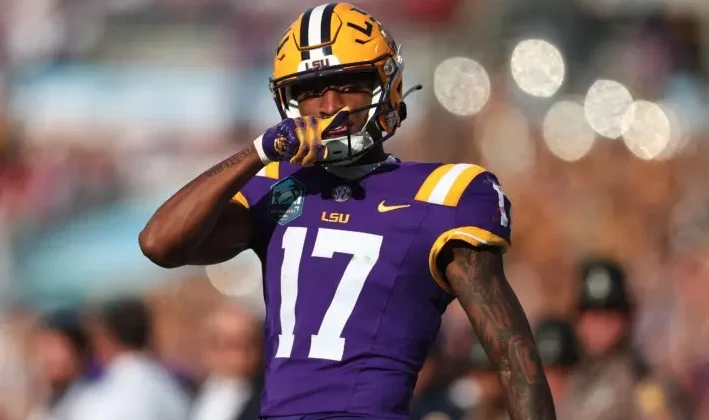
Right on his heels is LSU’s Chris Hilton Jr., who carries undeniable deep speed on tape. The 4.37 projection assumes a clean ramp-up and zero hesitation through the initial 10 yards. Hilton’s massive stride length allows him to close incredibly strong through the final phase, firmly locking his number in the elite low-4.3 tier.
While Georgia’s Zachariah Branch might not post the absolute top overall 40 time, his acceleration jumps off the turf. A projected 4.42 pairs with what scouts anticipate will be the best 10-yard split in the receiver group. Franchises demanding instant separation focus on that violent first phase as heavily as the final time.
Barion Brown mirrors that 4.42 projection but utilizes a different style. Brown relies on steady, repeatable speed rather than pure track burst. His film backs up the number. A relaxed, clean start could easily push him into the low 4.4s, guaranteeing his spot in the upper echelon of the testing group.
“I didn’t come here just to run fast; I came here to prove nobody can catch me when the ball is in the air. The stopwatch just puts a number on what the film already shows.”
— Brenen Thompson, Mississippi State Wide Receiver
The stopwatch drives the early buzz, but the true indicator of NFL longevity relies on pairing these elite times with fluid on-field drill work. If Thompson or Hilton crack the 4.30 barrier, expect immediate shifts in the late first-round and early second-round valuations. Cornerback-needy teams will scramble to match this perimeter speed. As the official times roll in between 4.34 and 4.38, general managers must decide if they are drafting pure track speed or functional football separation. The wide receiver run in April begins the second these athletes cross the finish line in Indianapolis.