

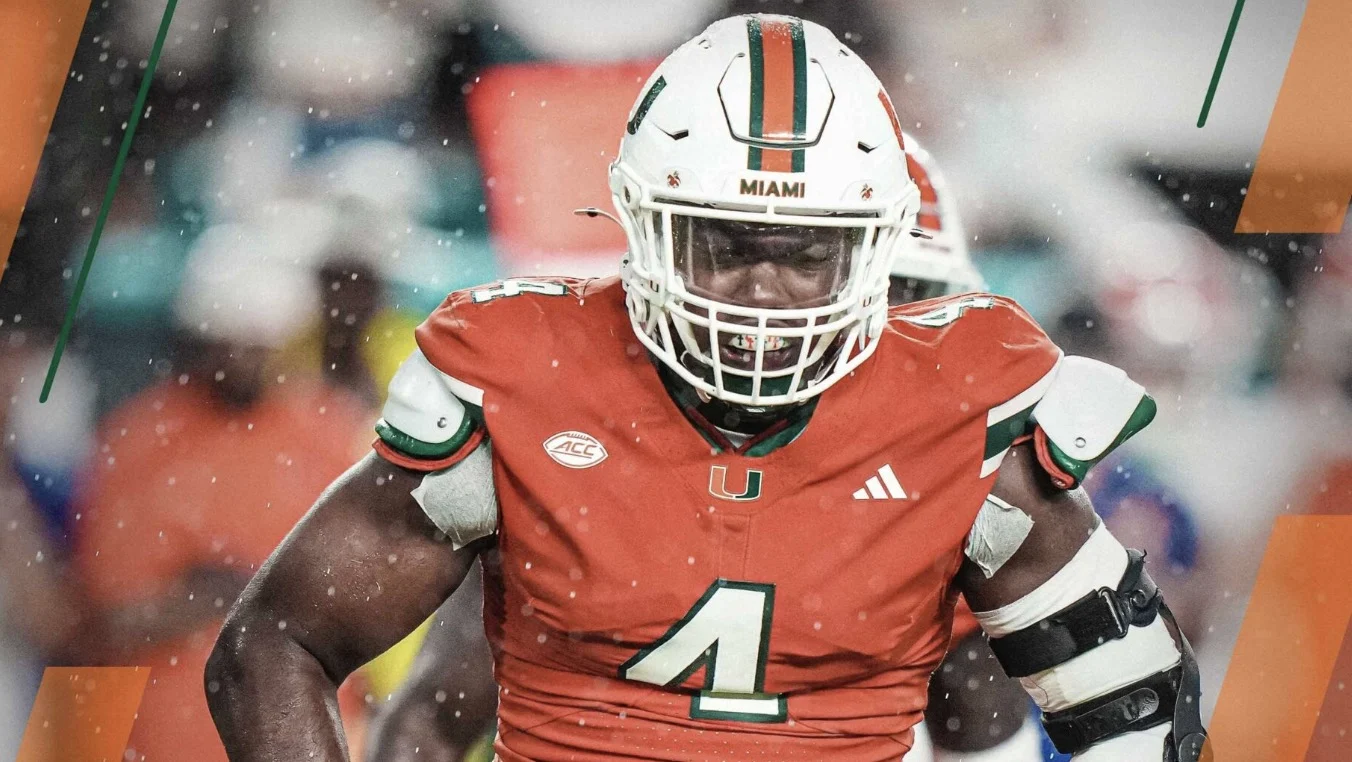
MOBILE, Ala. — Forget the tape measure. Burn the spreadsheets. While scouts in Mobile are obsessing over wingspans and hand sizes this week, Miami Hurricanes edge defender Rueben Bain Jr. has quietly put together one of the most destructive defensive seasons in college football history.
The numbers don’t just jump off the page; they scream. Bain finished the 2025 campaign with a staggering 92.4 pass-rush grade and led the entire nation with 83 total pressures. For context? That is lightyears ahead of the pack.
Here is the reality: Bain measures in around 6-foot-3, 275 pounds, with arms likely taping at 30 3/4 inches. In the traditional NFL scouting world, those arms are “too short” to play on the edge. That puts him in the bottom 10th percentile.
But watch five minutes of game film, and you see why the measurements are failing the scouts, not the player. Bain posted a 23.5% pass-rush win rate across 561 rush snaps. He didn’t just beat tackles; he embarrassed them.
While Texas Tech’s David Bailey and Auburn’s Keldric Faulk are earning rightful hype for their high-end traits, Bain stands alone as the most complete disruptor. He isn’t winning because he’s long; he’s winning because he’s a technician with a sledgehammer for a punch.
The knock on short arms is simple: offensive tackles will lock you out before you can get to their chest. Bain flips this logic on its head. He uses his density and leverage to get under pads, turning the offensive tackle’s length into a disadvantage.
Think we’re just hyping him? Listen to Hall of Fame tackle Joe Thomas, who has spent years debunking the arm-length obsession.
“It’s not that I don’t think arm length matters at all… but your job is to connect the person you’re blocking to your feet. It really doesn’t matter to have an inch or half an inch longer arms… especially because the way they measure it, they’re measuring how long are your fingers… which is not part of the strike.” — Joe Thomas, NFL Hall of Famer (via Green Light Podcast)
Bain lives this philosophy. He strikes with the base of his palm, uses a lethal “ghost” move to slip punches, and has the ankle flexibility to corner flat to the quarterback. When a tackle oversets to stop his speed? He counters inside with a club move that sends 320-pounders flying.
The NFL is changing. Defenses need chess pieces, not just stationary rooks. Bain’s superpower is his ability to kick inside. On passing downs, Miami slid him to a 3-technique or 4i, where he abused guards who lacked the foot speed to mirror him.
His 86.2 run-defense grade (9th nationally) proves he isn’t a liability on early downs, either. He resets the line of scrimmage violently. Yes, he misses tackles occasionally (over 15% missed tackle rate), and he can get too aggressive shooting gaps, leaving lanes open. But when you create 83 pressures, defensive coordinators will happily live with a few aggressive mistakes.
The next few months will be a battleground. Traditionalists will try to push Bain to defensive tackle exclusively. That would be a mistake. He is an edge rusher who can rush inside, not a tackle trying to play outside.
If he runs well at the Combine and shows that his flexibility matches the tape, Bain locks himself into the top 15. If teams overthink the arm length? Some lucky franchise in the 20s is getting the steal of the draft.